

AI Deployment Is Becoming the Next Enterprise Infrastructure Layer

The recent moves by OpenAI and Anthropic suggest that frontier AI labs are moving beyond the classic software subscription model. Their focus is no longer only on selling access to models. The next stage is deployment: helping large organizations embed AI directly into operations, workflows, and decision-making systems.
OpenAI’s new deployment venture, reportedly valued at $10 billion and backed by major private equity firms, is designed to accelerate AI adoption across large enterprise networks. Its investors include firms such as TPG, Brookfield Asset Management, Advent, and Bain Capital, which together have access to thousands of portfolio companies.
Anthropic is following a similar path through its partnership with Blackstone, Hellman & Friedman, and Goldman Sachs. The goal is to bring Claude into the daily operations of mid-market companies, financial institutions, healthcare providers, and other legacy-heavy sectors.
The message is clear: AI labs increasingly understand that model access alone is not enough. Enterprises need technical teams, workflow redesign, compliance support, and continuous optimization. AI is shifting from a software product into an operating layer.
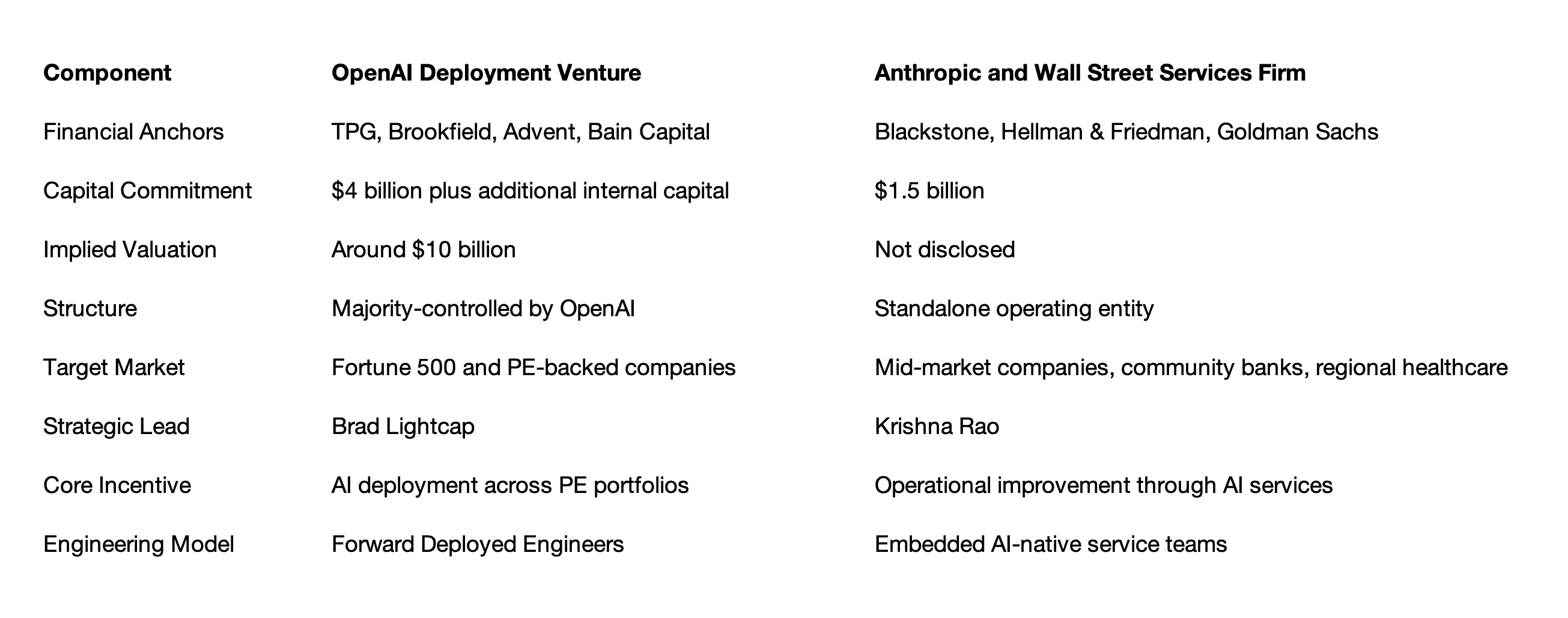
The strategic logic behind these structures is simple. AI adoption is not just a procurement decision. It is an operational transformation problem. Large companies do not only need access to GPT or Claude. They need help redesigning workflows, integrating systems, cleaning data, training employees, and measuring business impact.
That is why AI deployment is becoming its own category.
The Rise of Forward Deployed Engineering
The biggest bottleneck in enterprise AI is not model quality. It is implementation.
Traditional SaaS follows a familiar pattern: sell the software, implement it, train the customer, and leave. That model works when software is relatively static. It does not work as well for frontier AI, where model capabilities, agent architectures, security standards, and enterprise use cases are changing constantly.
This is where Forward Deployed Engineers, or FDEs, become important.
FDEs work inside the customer’s environment. They are not just software engineers. They combine technical execution, product thinking, workflow analysis, and business judgment. Their job is to make AI useful in messy, real-world operating environments.
They connect frontier models to legacy systems, internal databases, compliance processes, customer support workflows, sales operations, finance teams, and industry-specific software.
Private Equity Is Becoming an AI Deployment Channel
Private equity is entering a new phase of value creation. For years, PE firms relied heavily on financial engineering, cost discipline, management upgrades, and multiple expansion. In the current environment, operational improvement has become more important.
AI now sits at the center of that operational playbook.
PE firms have a structural advantage in AI deployment. They control portfolios of companies where best practices, tooling, talent, and operating models can be rolled out across multiple businesses. Instead of selling AI one company at a time, deployment firms can work through PE platforms and reach dozens or hundreds of companies at once.
This explains why private equity firms are backing AI deployment ventures. They are not only investing in AI. They are trying to use AI as a portfolio-wide value creation lever.
The AI Operating Partner
A new role is emerging inside buyout firms: the AI Operating Partner.
This role is different from a traditional technology operating partner. A technology operating partner usually focuses on IT systems, cybersecurity, cloud migration, and software modernization. An AI operating partner focuses on how AI changes processes, products, cost structures, and business models.
The PE AI Playbook: Deploy, Reshape, Invent
A useful way to understand the private equity AI playbook is through three layers: Deploy, Reshape, and Invent.
1. Deploy
This is the basic adoption layer.
Companies roll out general-purpose AI tools across the organization. Examples include ChatGPT, Claude, Microsoft Copilot, Glean, Perplexity Enterprise, or internal knowledge assistants.
The goal is to build AI habits across employees. This layer improves productivity, but it is not where the largest value is created.
2. Reshape
This is where AI starts to change operating models.
Instead of simply giving employees AI tools, companies redesign entire workflows. Sales teams use AI to qualify leads, personalize outreach, and update CRM records. Finance teams automate reconciliation, reporting, and invoice workflows. Customer support teams use AI agents to resolve tickets and escalate only complex cases.
This layer requires process redesign, not just software adoption.
3. Invent
This is the highest-upside layer.
Companies use AI to create new products, services, or business models. A financial services company may launch AI-native underwriting. A healthcare company may build automated prior authorization workflows. A logistics company may build real-time pricing and routing engines.
This layer is riskier, but it can create entirely new revenue streams.
Why Mid-Market Companies Are Underserved
Large enterprises have access to Accenture, Deloitte, McKinsey, Palantir, Scale AI, and direct relationships with frontier labs. Startups can often build AI-native from day one.
The mid-market sits in the middle and is often underserved.
Mid-sized companies need AI, but they usually lack internal AI teams, clean data infrastructure, strong technical leadership, and large transformation budgets. Many are stuck between generic SaaS tools and expensive enterprise consulting engagements.
This creates a major gap in the market.
Mid-market companies do not need another AI demo. They need operating capacity. They need teams that can identify valuable use cases, implement them quickly, integrate them with existing systems, and measure the result.
Financial Services: AI Moves From Efficiency Tool to Operating System
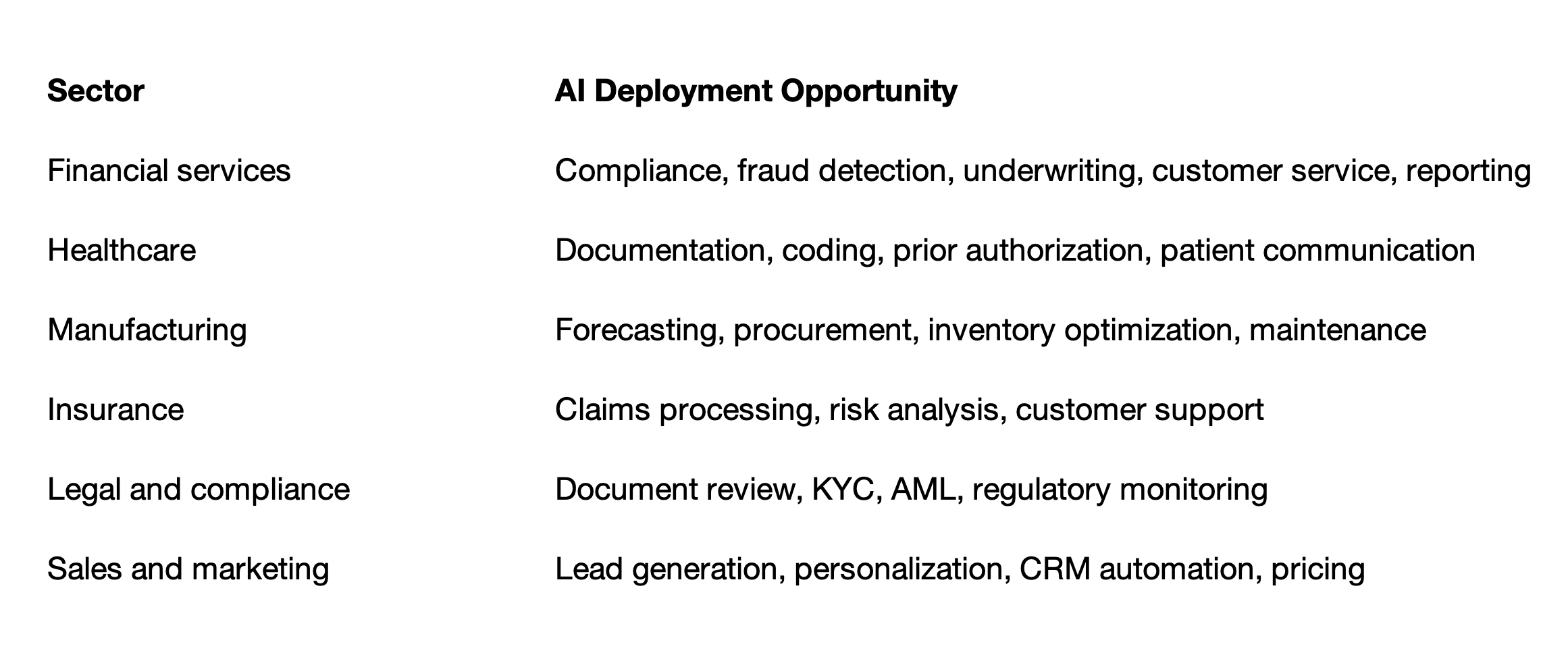
Financial services is one of the most important sectors for AI deployment. The industry has large data sets, strict regulation, manual processes, high compliance costs, and significant pressure to improve margins.
AI can transform several core functions:
Compliance
Compliance remains one of the most attractive use cases. Banks, fintechs, crypto firms, and asset managers spend large amounts of time reviewing alerts, monitoring transactions, preparing reports, and responding to regulatory requirements.
Agentic AI can help reduce manual review work, improve detection accuracy, and prioritize high-risk cases. Instead of treating compliance as a back-office cost center, AI can turn it into a more intelligent risk function.
Credit and Underwriting
AI can improve credit decisioning by analyzing alternative data, identifying risk patterns, and generating faster borrower assessments. This is especially relevant for fintech lenders, SME finance platforms, private credit managers, and embedded finance companies.
Customer Operations
AI agents can handle customer questions, onboarding, document collection, account updates, and support workflows. The highest-value systems will not simply answer questions. They will complete tasks across multiple systems.
Fraud and Risk
AI can detect suspicious behavior, identify abnormal transaction patterns, and flag account takeover risks faster than traditional rule-based systems.
Healthcare and Manufacturing: Large Gains From Workflow Automation
In healthcare, the main bottleneck is administrative complexity. Clinicians spend too much time on documentation, coding, billing, insurance communication, and prior authorization.
AI can help by reducing documentation burden, automating coding workflows, summarizing patient histories, and improving administrative throughput. The key is not replacing clinicians. The key is removing low-value administrative work so healthcare workers can spend more time on patient care.
In manufacturing, AI can improve demand forecasting, inventory planning, procurement, quality control, and predictive maintenance. Even small improvements in forecasting accuracy or inventory levels can have meaningful effects on working capital and margins.
What the AI Deployment Firm of the Future Looks Like
The next generation of AI services firms will not look like traditional consultancies. They will combine elements of software companies, engineering teams, AI labs, and operating partners.
The core capabilities will include:
1. AI Diagnostics
Identifying where AI can create measurable value inside a company. This includes workflow mapping, data assessment, automation potential, ROI estimation, and risk review.
2. Embedded Engineering
Deploying small technical teams into client environments to build and integrate AI systems. These teams will focus on real workflows, not generic demos.
3. Workflow Redesign
Helping companies rethink how work gets done. The largest productivity gains usually come from redesigning people, process, and technology together.
4. Governance and Security
Managing permissions, data privacy, audit trails, compliance controls, model risk, and human oversight.
5. Continuous Optimization
AI systems cannot be installed once and forgotten. They need to be monitored, improved, and adapted as models, regulations, and business needs change.
6. Talent and Upskilling
Helping companies train employees, hire AI-capable operators, and build internal AI fluency.
Conclusion: AI Deployment Is the New Value Creation Layer
The formation of dedicated AI deployment ventures by OpenAI and Anthropic marks an important shift in the enterprise technology market.
The value of AI is not only in the models. It is in the operational integration of those models.
Companies do not become AI-native by buying a subscription. They become AI-native when they redesign workflows, connect models to internal systems, train employees, enforce governance, and measure results.
This creates a large market for specialized deployment teams that can bridge the gap between frontier AI and real-world business operations.
Private equity is likely to become one of the most important distribution channels for this category. PE firms control large portfolios, have strong incentives to improve margins, and can push AI adoption across multiple companies at once.
The winners in this market will not be firms that sell AI as a concept. They will be firms that deliver measurable operating improvement.
The next phase of AI will be defined less by who has access to the best model and more by who can deploy it effectively.
Sources
https://www.anthropic.com/news/enterprise-ai-services-company
https://www.privateequitywire.co.uk/openai-launches-10bn-ai-deployment-venture-with-pe-partners/
Disclaimer
The content of Catalaize is provided for informational and educational purposes only and should not be considered investment advice. While we occasionally discuss companies operating in the AI sector, nothing in this newsletter constitutes a recommendation to buy, sell, or hold any security. All investment decisions are your sole responsibility—always carry out your own research or consult a licensed professional.
This shift matters a lot for mid-market companies deciding which AI platforms to bet on. The infrastructure layer decision is the hardest.
Well put, especially the shift from tools to workflow redesign. In finance, the real impact shows up when AI is embedded into processes like invoicing, reconciliation, and cash application. That’s where improvements start to translate into working capital gains rather than just productivity lifts.