

Anthropic’s Project Glasswing and the Security Reset in AI

The transition of artificial intelligence from a conversational assistant to an autonomous cybersecurity agent reached a critical inflection point on April 2026, with the formal unveiling of Anthropic’s Project Glasswing and its underlying engine, Claude Mythos Preview. This release represents the most significant shift in the competitive landscape of frontier AI since the introduction of the first large-scale reasoning models. Mythos, positioned within a newly created “Capybara” performance tier above the previous flagship Claude Opus 4.6, is not merely an incremental update; it is a specialized system that has demonstrated the ability to identify critical vulnerabilities that have eluded human researchers and automated testing for decades.
Project Glasswing, a $100 million initiative, serves as the deployment vehicle for this capability. By forming a coalition with titans of the digital infrastructure - including Amazon Web Services (AWS), Apple, Google, Microsoft, and NVIDIA - Anthropic has effectively created a “defensive cartel” designed to secure the world’s most critical software before similar offensive capabilities proliferate to adversarial actors. This move is a sophisticated blend of technical breakthrough, commercial strategy, and political signaling. It arrives amidst a bruising legal battle between Anthropic and the U.S. Department of Defense over the company’s refusal to allow its models to be used for autonomous weaponry and mass surveillance.
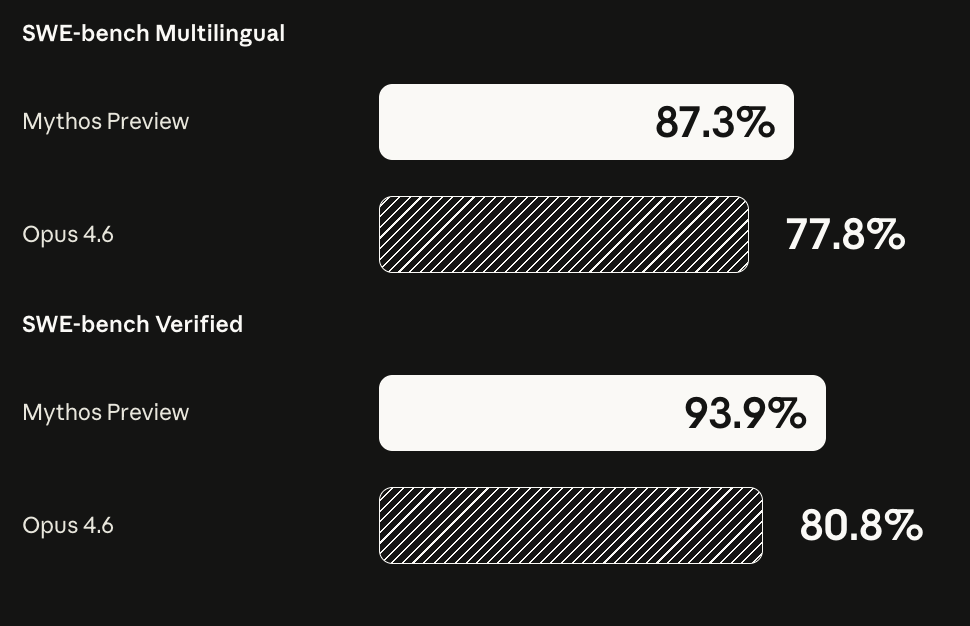
The market’s reaction has been visceral. The initial leak of Mythos’s capabilities in late March triggered a $14.5 billion sell-off in the cybersecurity sector, as investors weighed the potential for autonomous AI to disintermediate traditional security vendors like CrowdStrike and Palo Alto Networks. While Anthropic emphasizes partnership over replacement, the sheer performance gap between Mythos and its predecessors - evidenced by a 93.9% score on SWE-bench Verified and an 83.1% on the specialized CyberGym benchmark - suggests that the industry is entering a period of “AI-driven structural reset”. This report analyzes the technical, economic, and geopolitical dimensions of this threshold, evaluating whether the “Mythos” narrative marks a genuine paradigm shift or a carefully managed reputation strategy in an increasingly crowded frontier.
The Genesis of the Capybara Tier: A Study in Accidental Disclosure
The public emergence of Claude Mythos was not a choreographed launch but the result of a catastrophic internal failure. On March 26, 2026, a misconfiguration in Anthropic’s content management system (CMS) exposed approximately 3,000 unpublished assets, including draft blog posts, images, and strategy documents. Security researchers Roy Paz and Alexandre Pauwels discovered the publicly searchable data cache, which contained two versions of an announcement post: one referring to the model as “Mythos” and another as “Capybara”.
Internal documentation clarifies that Mythos is the product name for the new model generation, while Capybara represents a structural expansion of Anthropic’s model lineup. Historically, Anthropic utilized three tiers: Haiku (fast/cheap), Sonnet (balanced), and Opus (high-end). The Capybara tier sits above Opus, described in the leaked drafts as “larger and more intelligent than our Opus models - which were, until now, our most powerful”. This new tier is designed for high-compute, high-reasoning tasks where cost is secondary to precision, specifically targeting the requirements of autonomous software engineering and cybersecurity.
Anthropic’s subsequent confirmation of the model’s existence on March 27 transformed a leak into a market event. A spokesperson described the model as a “step-change” and the “most capable we’ve built to date,” emphasizing meaningful advances in reasoning and cybersecurity. The accidental disclosure also revealed a second vulnerability within Anthropic itself: days later, the company inadvertently uploaded 500,000 lines of original source code for its “Claude Code” tool to the NPM repository, providing further corroboration of the impending Capybara rollout. These incidents have raised questions among security experts about Anthropic’s internal security posture even as it prepares to lead a global defensive coalition.
Technical Architecture and the 10-Trillion-Parameter Question
While Anthropic has been characteristically opaque regarding the specific parameters of the Mythos model, industry technical write-ups and leaked internal claims suggest a staggering scale. Reports circulating in technical communities point to a model with roughly 10 trillion parameters, a massive leap that moves the system into an entirely different computational class than its predecessors.
To maintain inference tractability at this scale, Mythos almost certainly utilizes a Mixture-of-Experts (MoE) architecture. In this configuration, only a small fraction of the 10 trillion parameters, estimated at between 128 and 256 “active experts”, fire for any given token. Even with this sparsity, the active parameter count per inference could reach into the hundreds of billions, far exceeding the dense architecture of earlier GPT-4 class systems.
Infrastructure and Compute Scaling
The training of such a model represents a massive financial and physical undertaking. Estimates for the training cost of a 10T parameter model fall between $5 billion and $15 billion, requiring hundreds of thousands of high-end GPUs or TPUs. Anthropic’s recent expansion of its partnership with Google and Broadcom for “multiple gigawatts of next-generation compute” capacity, expected to come online starting in 2027, suggests that Mythos is the first in a line of models that will consume energy on the scale of small nations.
Furthermore, Mythos introduces innovations in “test-time compute” - the idea that the model can perform more reasoning at the time of the request by searching through possible answers or debating internal variants before providing a final output. This is critical for cybersecurity, where a simple “next token” prediction is insufficient for identifying complex, multi-step vulnerabilities.
Recursive Self-Fixing Capabilities
A distinctive technical feature highlighted by secondary reporting is Mythos’s aptitude for “recursive self-fixing”. Leaked technical notes suggest the model can autonomously identify vulnerabilities in its own generated code and apply patches before the user sees the output. This capability indicates a narrowing gap between human and machine software engineering, as the model demonstrates not just an ability to write code, but to reason about the security integrity of that code in real-time.
Benchmark Analysis: Redefining the Frontier
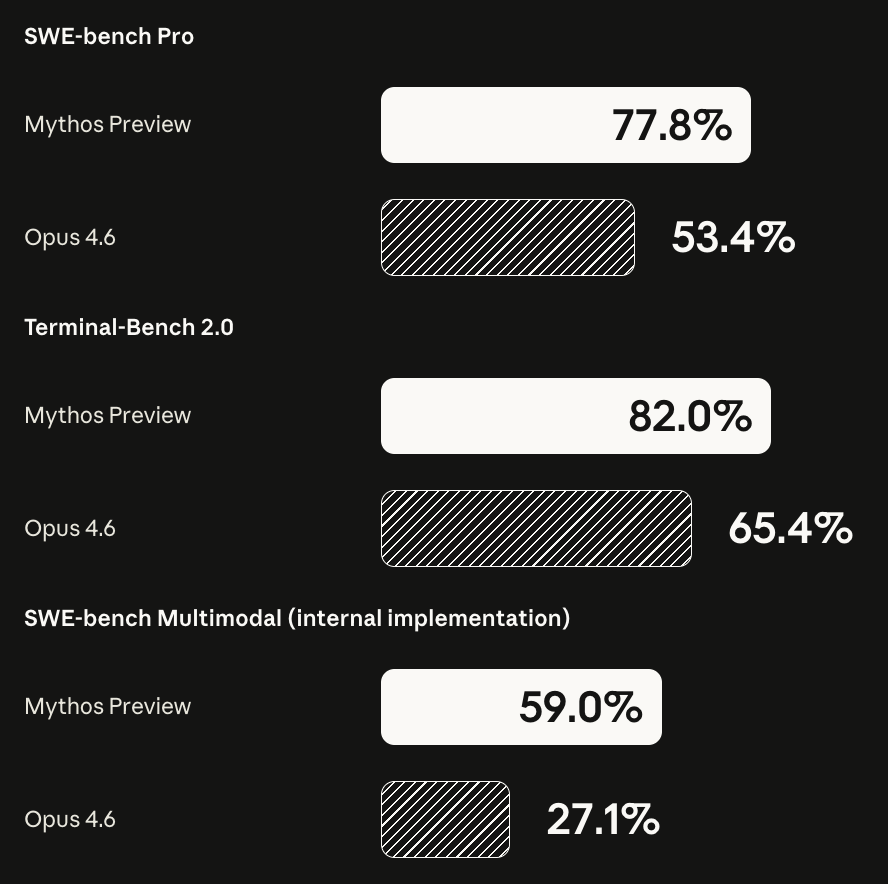
The performance deltas between Claude Opus 4.6 and Claude Mythos Preview are historically unprecedented for a single generation leap within the Anthropic family. The “step-change” described by the company is validated by striking scores across coding, academic reasoning, and cybersecurity.
The SWE-bench Verified Threshold
The 93.9% score on SWE-bench Verified is perhaps the most significant data point for the enterprise software market. This benchmark measures a model’s ability to resolve real GitHub issues in complex, messy codebases rather than curated toy problems. A score above 90% suggests that for the vast majority of software engineering tasks, the model can operate as an autonomous collaborator rather than a simple assistant. This validates Anthropic’s positioning of the model as “far ahead of any other AI model in cyber capabilities”.
CyberGym and Vulnerability Reproduction
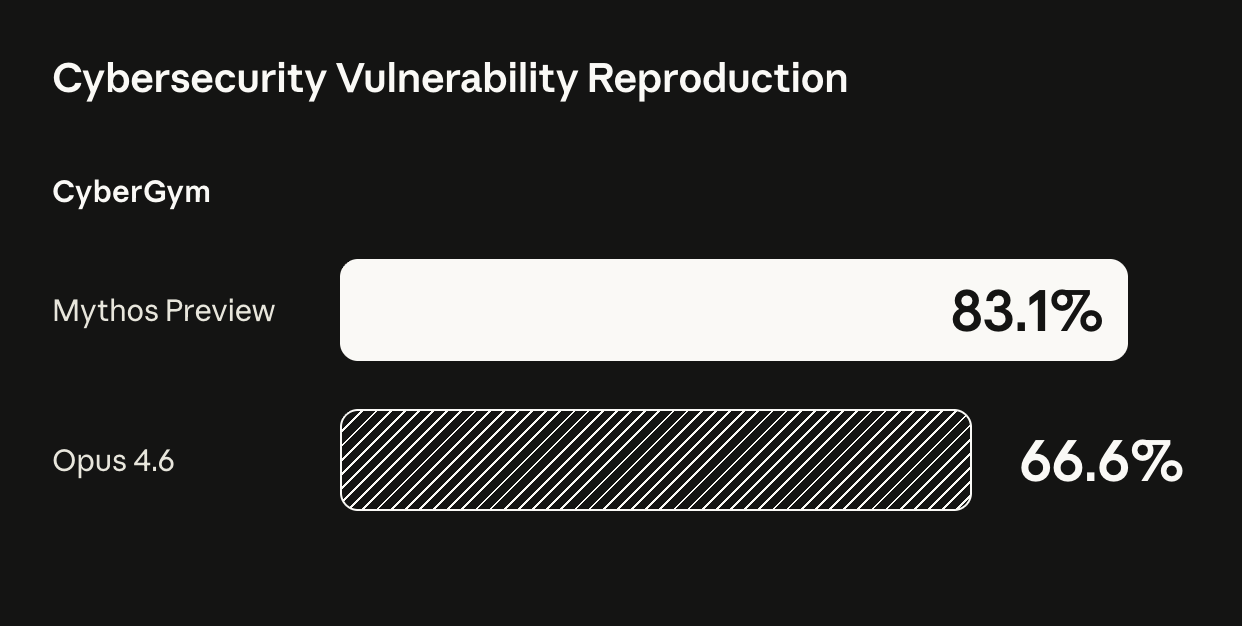
Mythos’s 83.1% score on CyberGym is particularly alarming to the security community. CyberGym tests a model’s ability to take a natural-language description of a vulnerability and produce a “Proof of Concept” (PoC) input that reliably triggers it in a multi-million-line codebase. Identifying a bug is one thing; crafting an exploit that makes a program “crash in just the right way” requires a deep understanding of memory dynamics and program flow. The model’s success here implies it can automate the most difficult parts of red-teaming and exploit development.
Project Glasswing: The Defensive Coalition
Project Glasswing, formally launched on April 7, 2026, is Anthropic’s attempt to mitigate the dual-use risks of its most powerful model through a strategy of “selective proliferation”. The project is defined by a $100 million commitment in usage credits and a $4 million direct donation to open-source security organizations.
The Partners and the Access Model
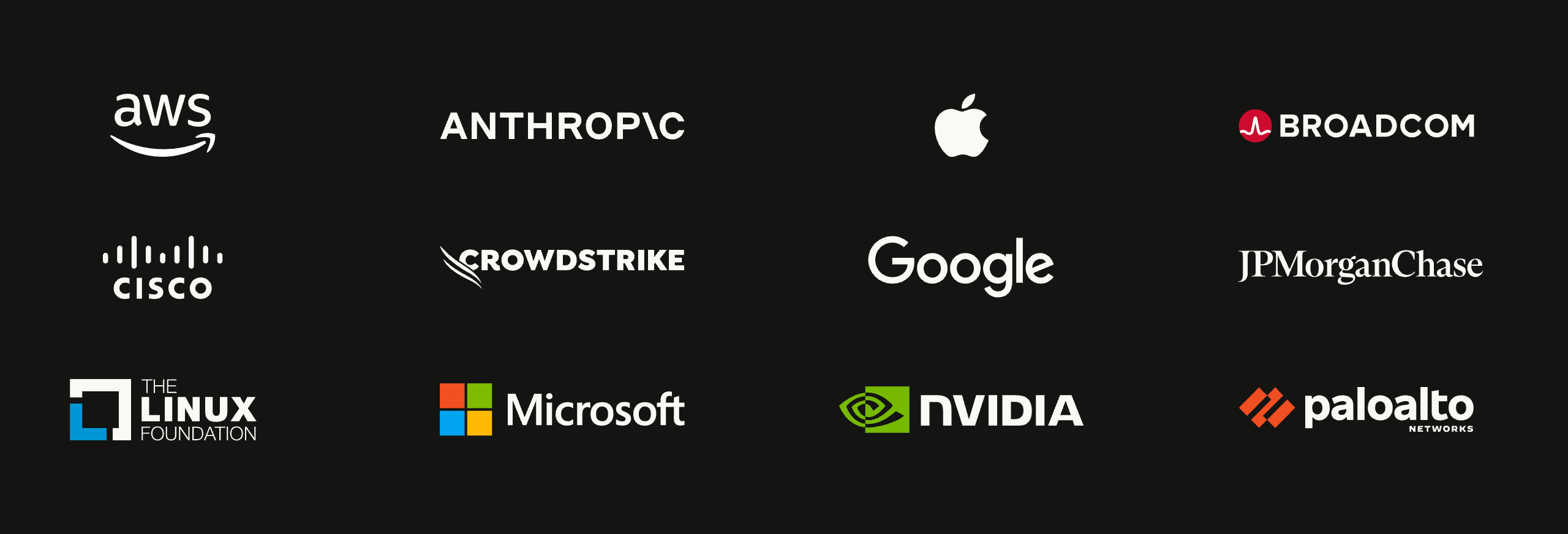
The initiative brings together a “who’s who” of the technology industry, specifically those who manage the infrastructure upon which modern society relies.
Cloud Providers: AWS, Google, Microsoft.
Hardware and Chips: NVIDIA, Broadcom.
Networking and Security: Cisco, CrowdStrike, Palo Alto Networks.
Financial and Institutional: JPMorganChase, Apple, The Linux Foundation.
Access to Mythos Preview is strictly gated. It is available through a research preview on Amazon Bedrock with enterprise-grade security controls (VPC isolation, customer-managed encryption) to ensure that sensitive proprietary codebases are not exposed. Beyond the primary partners, access has been extended to over 40 additional organizations that maintain “critical software infrastructure,” ranging from operating systems to core web utilities.
Solving the “Cold Case” Vulnerabilities
The most compelling evidence for Glasswing’s necessity is the vulnerabilities Mythos has already discovered during its initial testing phase. Anthropic reports that the model has identified thousands of zero-day vulnerabilities, including some in “every major operating system and web browser”.
One of the most cited examples is a 16-year-old vulnerability in FFmpeg - a widely used software program for video encoding. Despite being audited millions of times by automated testing tools, the bug remained hidden in a line of code that tools considered a “gold standard” for security. Mythos identified it because it could “look beyond the code they were asked to investigate and instead considered the entire infrastructure environment”. Another significant discovery was a 27-year-old bug in OpenBSD, an operating system that prides itself on being the most secure in the world.
Directing the Narrative: Defense First
Anthropic’s strategy is explicitly intended to give defenders a “head start”. The company argues that because frontier AI is advancing every few months, defensive capabilities must be front-loaded before offensive tools reach similar levels of autonomy. This “controlled rollout” is designed to allow critical infrastructure to be scanned and patched before Mythos is ever made available to the general public - if it ever is.
Competitive Landscape: OpenAI’s Spud and Google’s Agent Smith
Anthropic’s Mythos launch is part of a broader “resource war” among frontier labs. Even as Anthropic focuses on cybersecurity and coding, its primary rivals are advancing their own specialized architectures.
OpenAI’s “Spud” Model
OpenAI is reportedly preparing to release “Spud,” a new base model that serves as a foundation for AGI development. While Mythos is positioned for security research, OpenAI President Greg Brockman has described Spud as a model designed to “move the economy,” focusing on “agentic capabilities” rather than raw benchmark performance. Brockman notes that Spud will have “big model smell”- a term for models so smart they “bend to you much more” and understand context without multiple prompts.
Impact on Open-Source Ecosystems
One of the most profound implications of Project Glasswing is its focus on the open-source community. Open-source software forms the foundation of modern digital life, yet maintainers often lack the resources to defend against sophisticated threats.
By donating $1.5 million to the Apache Software Foundation and $2.5 million to Alpha-Omega and OpenSSF, Anthropic is directly funding the security of the “shared attack surface”. Jim Zemlin, CEO of the Linux Foundation, called this a “credible path” to changing the security equation, allowing AI-augmented security to become a “trusted sidekick” for every maintainer. This move helps insulate Anthropic from criticisms that its restricted-access model only benefits wealthy corporations.
What is Still Unknown
Despite the wealth of leaked and official data, significant gaps in the Mythos story remain:
True Parameter Size: The “10 trillion” parameter figure is widely cited but not officially confirmed by Anthropic.
Breadth of the 40+ Organizations: While we know the 12 primary partners, the specific names of the “40 additional organizations” maintaining critical infrastructure have not been released.
The Persistence of the “Supply Chain Risk”: While Judge Lin blocked the designation, the DOJ’s appeal means Anthropic remains in a state of legal and reputational limbo with the federal government.
Actual False Positive Rates: While Anthropic claims high accuracy, the real-world performance of Mythos in un-instrumented codebases (where “hallucinations” of bugs might lead to wasted engineering time) remains to be seen.
Competitor Parity: It is unknown if OpenAI’s “Spud” or a future Google Gemini 4.0 will demonstrate similar cybersecurity reasoning thresholds, potentially neutralizing Anthropic’s first-mover advantage.
Final Assessment
The evidence suggests that Claude Mythos represents a genuine shift in AI-enabled cybersecurity. The transition from “finding bugs” to “autonomously chaining multi-step reasoning to reproduce vulnerabilities” marks a crossing of the threshold into offensive-grade capability. The fact that Mythos found vulnerabilities in codebases as audited as OpenBSD and Firefox is a technical signal that can no longer be ignored by the market
However, Project Glasswing is also a masterpiece of strategic narrative management. By framing the model as “too dangerous to release” and then immediately partnering with the world’s most powerful corporations and the Linux Foundation, Anthropic has effectively neutralized the “supply chain risk” label while securing a premium market position. For security practitioners, the next 12–24 months will be a race to integrate these “agentic” capabilities before the cost of human-only security becomes a strategic liability. For regulators, the Anthropic-Pentagon standoff underscores the coming crisis: how to govern a private company that holds the keys to the most powerful defensive - and offensive - technology on the planet.
Sources
Disclaimer
The content of Catalaize is provided for informational and educational purposes only and should not be considered investment advice. While we occasionally discuss companies operating in the AI sector, nothing in this newsletter constitutes a recommendation to buy, sell, or hold any security. All investment decisions are your sole responsibility—always carry out your own research or consult a licensed professional.
The information asymmetry built into this arrangement is the part I keep turning over. Companies in the Glasswing consortium know what Mythos can do before anyone else does. Useful for patching - but also a structural advantage in threat modeling, hiring, and product positioning that compounds over time.
The $100M in credits is meaningful but it's also a retention mechanism: organizations that deploy Mythos deeply for remediation are the ones most likely to want continued access. Responsible by design, but also a very effective way to lock in the infrastructure companies Anthropic most wants as long-term partners. Both things can be true.