

Google Launches Gemini 3.5 Flash

The launch of Gemini 3.5 Flash on May 19, 2026, represents the definitive transition of the artificial intelligence narrative from isolated model performance to integrated infrastructure and economic substitution. As unveiled at Google I/O 2026, this release does not merely update a model architecture. It reconfigures the enterprise productivity stack by prioritizing throughput, latent reasoning speed, and the vertical integration of hardware-to-agent orchestration.
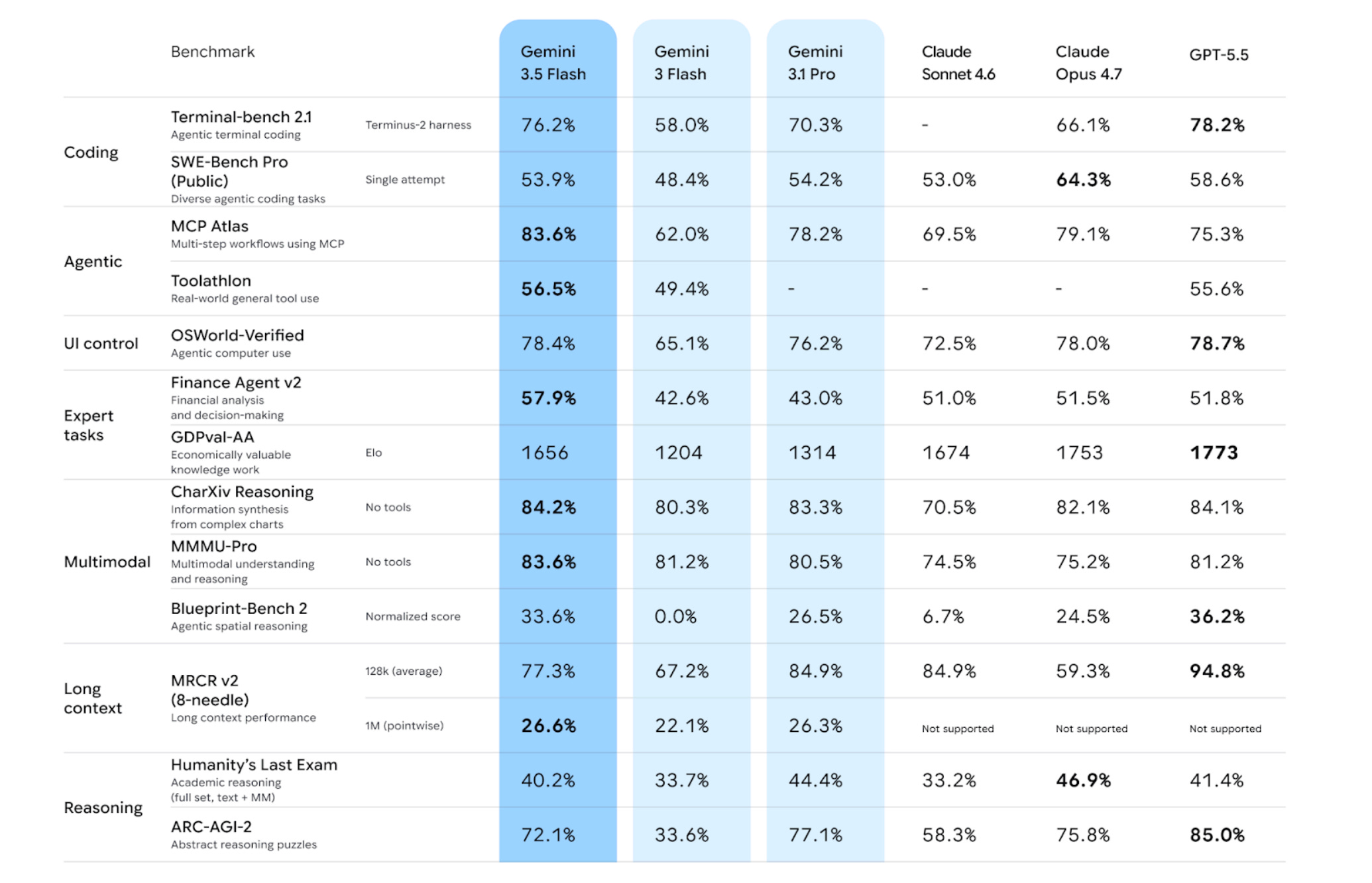
This is viewed not as a simple iteration of a chatbot, but as the deployment of a new industrial-scale utility for the cognitive economy. By aligning the Gemini 3.5 family, specifically the Flash variant, with the TPU v6 Trillium infrastructure and the Antigravity 2.0 agent platform, Google is attempting to solve the fundamental intelligence-speed-cost trade-off that has constrained enterprise adoption of large language models since their inception.
The Structural Infrastructure Thesis
The fundamental premise of the Gemini 3.5 Flash release is that the value of artificial intelligence in 2026 is captured at the intersection of silicon efficiency and agentic throughput. Google’s capital expenditure, which reached an unprecedented $180 billion to $190 billion in 2026, has been directed toward building a unified stack where the model is optimized for the specific mathematical kernels of the underlying Tensor Processing Units.
This vertical integration allows Gemini 3.5 Flash to operate as a high-velocity reasoning engine, capable of 4x the output speed of competing frontier models and up to 12x the speed when deployed within Google’s proprietary Antigravity environment.
The Trillium Economic Moat and TPU v6 Architecture
The economic viability of agentic workflows, where a single human objective may spawn dozens of sub-tasks and thousands of token generations, is entirely dependent on the cost per token at scale. Google’s TPU v6 Trillium, specifically the v6e variant, provides the physical foundation for this economic moat. By doubling the Interchip Interconnect bandwidth relative to the v5p generation, Trillium reduces the coordination latency that typically degrades performance in multi-agent orchestration.
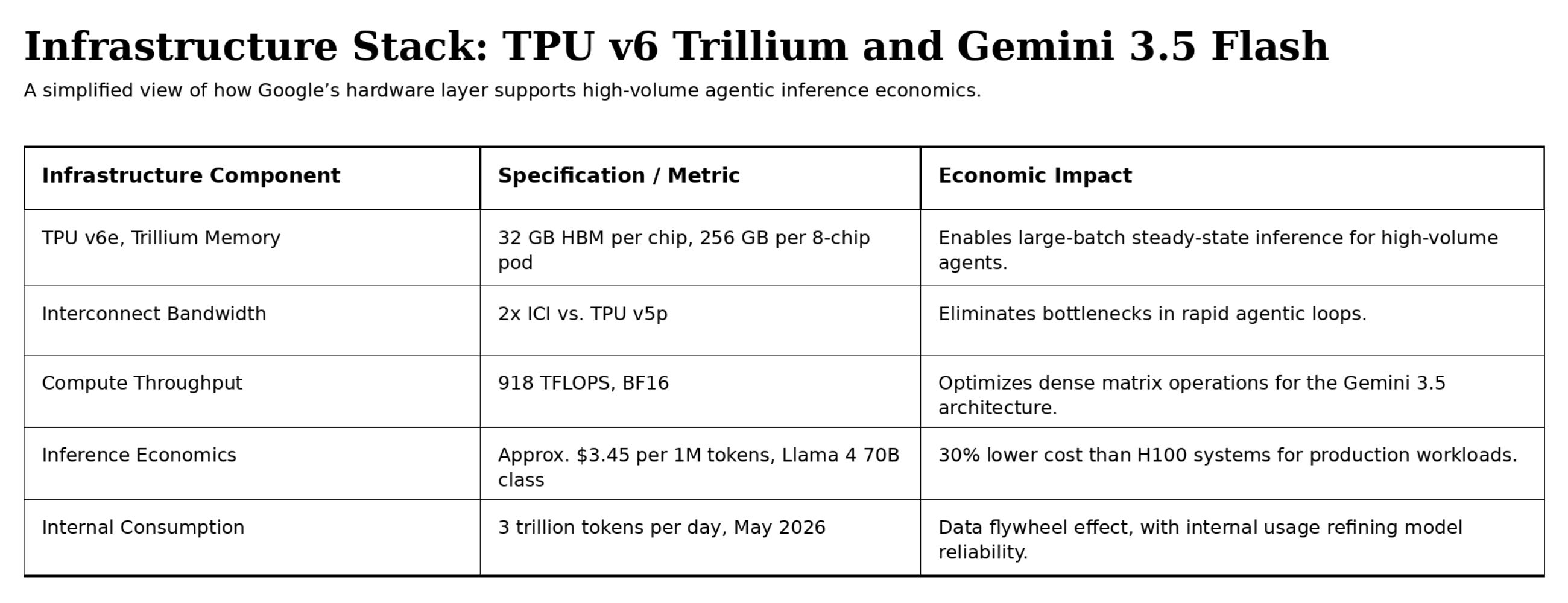
The decision to focus on the Flash series as the primary agentic engine is a strategic recognition that for 80% of enterprise workloads, the bottleneck is not peak reasoning but latency-weighted cost. The TPU v6e’s lack of native FP4 support is countered by its extreme efficiency in BF16 dense transformer models, making it the ideal substrate for Gemini 3.5 Flash’s 128k to 1M token context windows.
This hardware advantage allows Google to price Gemini 3.5 Flash at one-third to one-half the cost of comparable frontier models, effectively commoditizing high-quality reasoning for mass-market agentic applications.
The Internal Data Flywheel: Scaling to 3 Trillion Tokens
The structural advantage of the Google ecosystem is best illustrated by its internal consumption metrics. In March 2026, Google developers were reportedly processing 500 billion tokens per day on the Antigravity platform. By the time of the I/O 2026 keynote in May, this volume had surged to over 3 trillion tokens per day.
This internal token-hungry workflow serves as a massive stress test for the Gemini 3.5 Flash model, allowing Google to identify where the model excels at agentic decoding and thought preservation before wider release.
This scale allows Google to treat model training and inference not as a cost center, but as a manufacturing process. By operating at this volume, Google can amortize the immense fixed costs of fab capacity and data center construction across a token output that dwarfs most competitors. The result is a system where the intelligence of the model is inextricably linked to the utility of the infrastructure, creating a cycle where increased usage leads to lower costs, which in turn drives further agentic integration.
The Model Capability vs. Economic Substitution Framework
In the catalaize view, the traditional benchmarking of large language models on academic datasets is increasingly decoupled from their real-world economic value. The release of Gemini 3.5 Flash shifts the goalpost from score-seeking to task resolution. The model is explicitly marketed as a substitute for high-value human labor in specific, repeatable, and high-complexity workflows.
Benchmarking the New Cognitive Workforce
The performance of Gemini 3.5 Flash across agentic-specific benchmarks provides a clear indication of its target markets: software engineering, financial analysis, and complex visual comprehension. It is significant that this lightweight model outperforms the previous generation’s flagship, Gemini 3.1 Pro, across almost every major metric while being substantially faster.
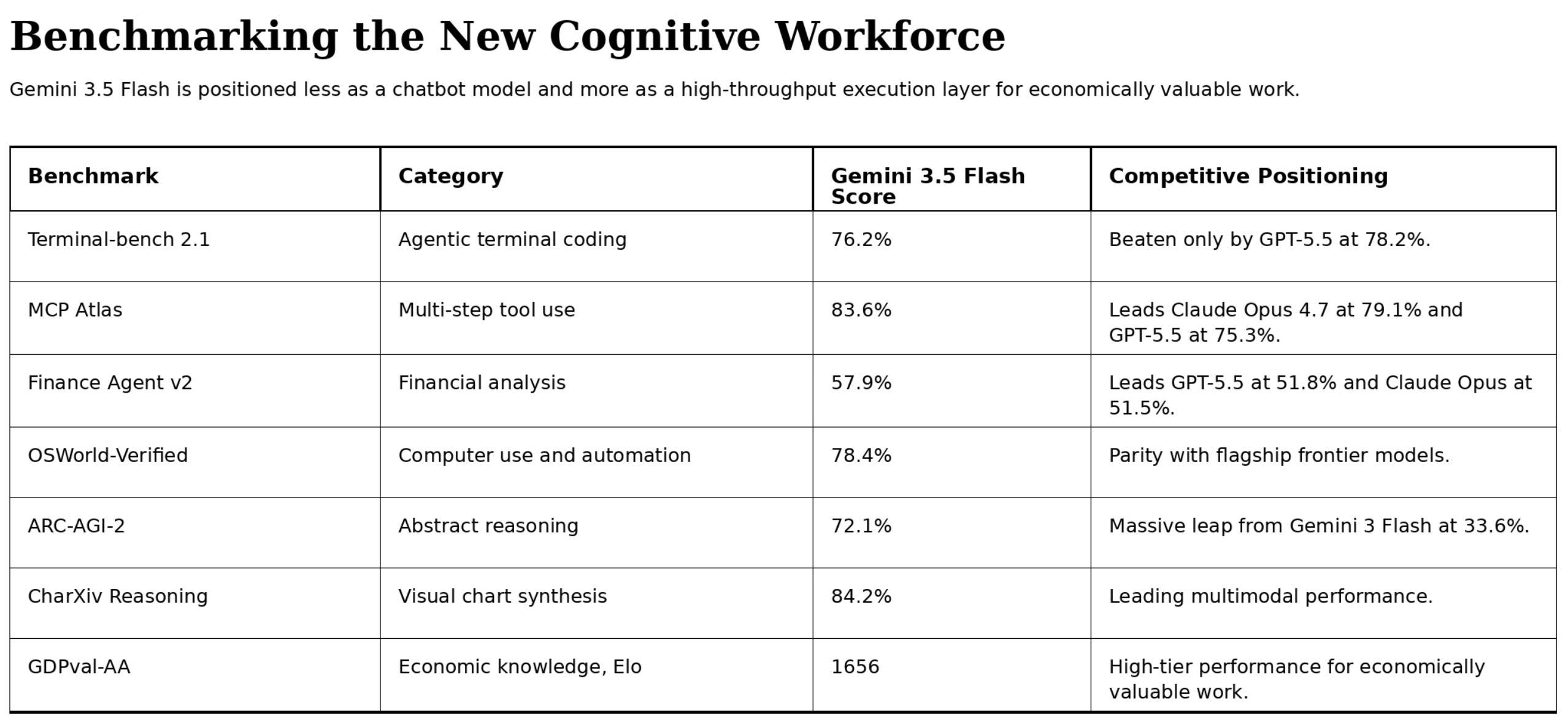
The surge in ARC-AGI-2 performance, from 33.6% in the previous version to 72.1% in Gemini 3.5 Flash, is perhaps the most striking technical achievement. This indicates a transition from pattern matching to actual abstract reasoning, which is a prerequisite for agents to handle zero-day problems in production environments where they cannot rely on training data precedents.
Furthermore, its lead in Finance Agent v2 and CharXiv suggests that Google has optimized the model for the dense document workflows of the financial services industry, where synthesizing information from complex charts and tables is a primary labor cost.
The Labor Substitution Thesis: Slashing Enterprise Costs
The economic promise of Gemini 3.5 Flash is centered on its ability to slash enterprise AI costs by more than $1 billion a year. This claim is based on a fundamental shift in how Chief Information Officers manage their AI portfolio. Historically, enterprises were forced to route complex reasoning tasks to slow, expensive flagship models while using lightweight models only for simple summaries. Gemini 3.5 Flash breaks this brittle system by offering reasoning quality that is almost 90% of the performance of frontier models, but at the speed and cost profile of a lightweight model.
Early validation from sectors such as life sciences and cybersecurity confirms the potential for deep labor substitution:
Life Sciences: Early adopters reported 96.4% greater accuracy in data extraction and scientific calculations when moving to the 3.5 Flash architecture.
Financial Services: A 46.7% improvement in the speed and accuracy of building financial reports from unstructured data suggests the model can effectively replace entry-level analyst tasks.
Cybersecurity: The model demonstrated a 42% improvement in multi-turn cyber benchmarks while reducing token consumption by 72%, indicating it can handle long-range security investigations with far higher efficiency than previous systems.
These gains are facilitated by the model’s Thinking Level parameter, which allows enterprises to balance the thinking budget against cost and latency. By setting a Medium or High thinking level for critical financial audits and a Minimal level for customer support chat, organizations can dynamically allocate their cognitive resources within a single unified API.
Google’s Platform State and Competitive Realignment
Google’s strategy with Gemini 3.5 Flash represents a platform state maneuver designed to capture the developer ecosystem through superior toolchains. The move away from an IDE-centric world to an agent-centric world is best exemplified by the release of Google Antigravity 2.0.
From Autocomplete to Mission Control: Antigravity 2.0
Antigravity 2.0 is a standalone desktop application that radically alters the user experience of software development. It is not a code editor in the traditional sense. It is a mission control system for managing autonomous agents. The interface is divided into an Editor for synchronous, human-driven code and an Agent Manager for high-level orchestration.
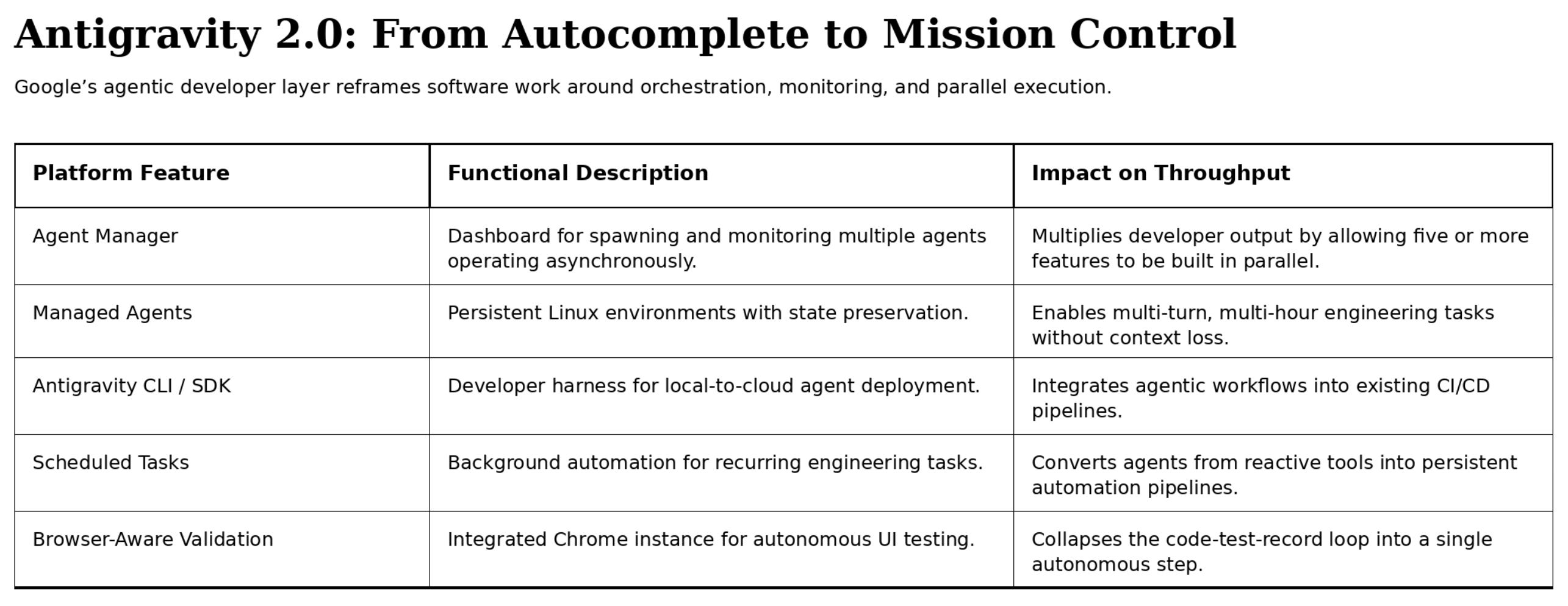
The transition from vibe-coded prototypes in Google AI Studio to production-ready applications in Antigravity is a core part of the developer experience. By allowing developers to export code directly from a prompt-based interface into an agent-managed repository, Google is lowering the barrier to entry for complex software engineering.
This shift addresses the cognitive load bottleneck identified by partners such as Accenture, where the complexity of modern infrastructure often overwhelms human developers.
Competitive Dynamics: The Execution Tier Battle
The 2026 AI market is characterized by a divergence in model philosophy. While Anthropic’s Claude 4.6 and 4.7 Opus continue to hold a slight lead in depth and precision for highly ambiguous reasoning tasks, such as multi-file refactoring on massive legacy codebases, Google’s Gemini 3.5 Flash has claimed the Execution Tier.
The price difference between Gemini 3.5 Flash and Claude Sonnet 4.6, a roughly 20x gap, makes the Flash model the only viable choice for high-volume multimodal processing and agentic sub-steps where reliability and cost are paramount.
For most engineering teams, the smart strategy involves using both: leveraging the precision of Claude Opus for core architecture and the high-throughput efficiency of Gemini Flash for implementation, testing, and documentation.
The Agentic Infrastructure Interaction Layer
The release of Gemini 3.5 Flash also introduces a more sophisticated interaction layer, moving beyond the simple chat interface to a more structured way for humans and agents to collaborate.
Artifacts and the External Hippocampus
A recurring problem in autonomous systems is drift, where an agent left to its own devices for several hours begins to diverge from the project’s original goals. Google addresses this through Artifacts and Memory Banks.
Artifacts: Every action taken by an Antigravity agent produces a verifiable deliverable, including task lists, implementation plans, screenshots, and browser recordings. This allows the human mission operator to review the agent’s work at any stage, creating a mechanism for trust through inspectability.
Memory Bank, or the External Hippocampus: Files such as projectbrief.md and systemPatterns.md act as a persistent context layer. Unlike the volatile context window of a chatbot, the Memory Bank ensures that architectural decisions made at the start of a project are preserved across hundreds of independent agent sessions.
Skills and Progressive Disclosure
To further optimize token efficiency and agent performance, Google has introduced Skills through SKILL.md files. This is a reusable capability layer that allows teams to package complex logic into modular files. An agent only reads a specific skill file when it becomes relevant to the task at hand, a process Google calls progressive disclosure.
This allows for the creation of highly specialized agents, such as a finance-data-fetcher or a security-vulnerability-fixer, that maintain a high degree of precision without overwhelming the model’s focus.
Governance, Security, and SynthID
As AI becomes the primary author of the world’s code and media, the infrastructure for governance becomes critical.
Secure Cloud Boundaries: The Gemini Enterprise Agent Platform ensures that all agent activity runs within a secure, governed cloud environment where customer data remains under the user’s control.
CodeMender: This AI security agent is specifically designed to find and fix vulnerabilities in the code being written by other agents, providing a necessary layer of autonomous oversight for the digital workforce.
SynthID Watermarking: For Gemini Omni, Google’s new video-as-a-partner model, all generated content includes digital watermarking to support responsible media governance and combat deepfake risks.
The Multimodal World Model: Gemini Omni
A significant but under-discussed part of the Gemini 3.5 release is Gemini Omni, which Google DeepMind CEO Demis Hassabis described as a significant leap toward artificial general intelligence. Unlike traditional video generators that respond only to text prompts, Gemini Omni is positioned as a world model that understands the physics of reality, including gravity, kinetic energy, and fluid dynamics.
This allows for a new type of partnered creation where users can edit video through conversational prompts or place their own AI avatars into generated scenes. From an infrastructure perspective, Gemini Omni, specifically the Flash variant, represents the expansion of the agentic loop from the digital world of code and text to the visual world.
This has profound implications for industries such as advertising, gaming, and education, where high-fidelity simulation can now be generated at the speed of thought.
Personal Intelligence: Gemini Spark and the Daily Brief
For the consumer market, Gemini 3.5 Flash powers Gemini Spark and the Daily Brief feature. These features represent the transition of Gemini from a search enhancement to a proactive life assistant.
By distilling priorities from Gmail, Calendar, and Workspace into a single Top of Mind view, Google is utilizing the long-context capabilities of 3.5 Flash to act as a personal intelligence layer. This is not just about answering questions. It is about taking action on the user’s behalf while remaining under their direction.
catalaize Outlook
The catalaize analysis of the Gemini 3.5 Flash release suggests a structural shift in the trajectory of the AI economy. The market has moved past the era of model-as-a-destination, represented by the chatbot, and into the era of model-as-a-utility, represented by agentic infrastructure.
The Dominance of the Execution Tier
The most significant takeaway is that the peak intelligence of a model is no longer the primary determinant of its economic utility. In a world where 90% of the performance of a flagship model can be delivered at one-twentieth of the cost and 4x the speed, the center of gravity in the AI market will inevitably shift to the Execution Tier.
Google, through its vertical integration of TPU v6 hardware and the Antigravity software stack, has positioned itself as the landlord of this new infrastructure.
The End of the Synchronous Human Bottleneck
The introduction of Antigravity 2.0 and async-first agent management marks the beginning of the end for the synchronous human developer bottleneck. When a single engineer can manage five or ten autonomous agents, each capable of handling 30-minute tasks independently, the unit of productivity shifts from the hour of work to the outcome achieved.
This will likely lead to a massive deflation in the cost of software development, coupled with a surge in the volume and complexity of the global codebase.
The Trust and Governance Challenge
The final hurdle for the agentic enterprise is not technical, but institutional. While Google has provided tools for transparency, including Artifacts, CodeMender, and SynthID, the ultimate success of these systems will depend on how organizations redefine their human-in-the-loop protocols.
The most successful enterprises will be those that transition from doing the work to directing the workforce, utilizing the speed and cost advantages of Gemini 3.5 Flash to build a resilient, autonomous, and governed digital core.
Google has effectively placed a bet: that the winner of the AI race will not be the one with the smartest model, but the one with the most efficient cognitive factory. With Gemini 3.5 Flash, the factory is now open.
Sources
https://deepmind.google/models/model-cards/gemini-3-5-flash/
https://storage.googleapis.com/deepmind-media/gemini/gemini_3-5_flash_model_evaluation.pdf
Disclaimer
The content of Catalaize is provided for informational and educational purposes only and should not be considered investment advice. While we occasionally discuss companies operating in the AI sector, nothing in this newsletter constitutes a recommendation to buy, sell, or hold any security. All investment decisions are your sole responsibility—always carry out your own research or consult a licensed professional.