

OpenClaw: From Viral Prototype to Agentic Infrastructure

As of February 2026, the artificial intelligence landscape has undergone a structural pivot from conversational large language models (LLMs) to autonomous agentic frameworks. At the center of this shift is OpenClaw, an open-source personal AI assistant that has achieved a level of institutional and developer traction previously unseen in the software-as-a-service (SaaS) era.
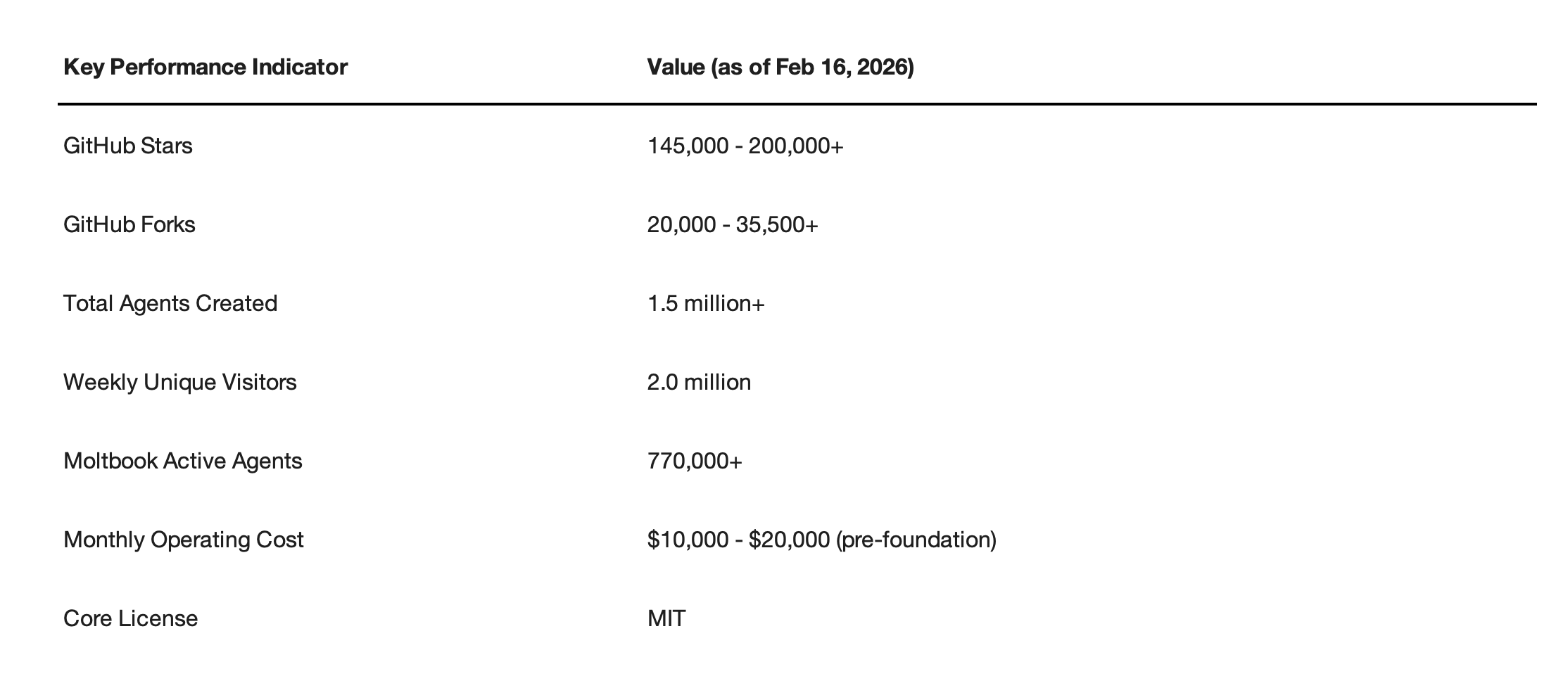
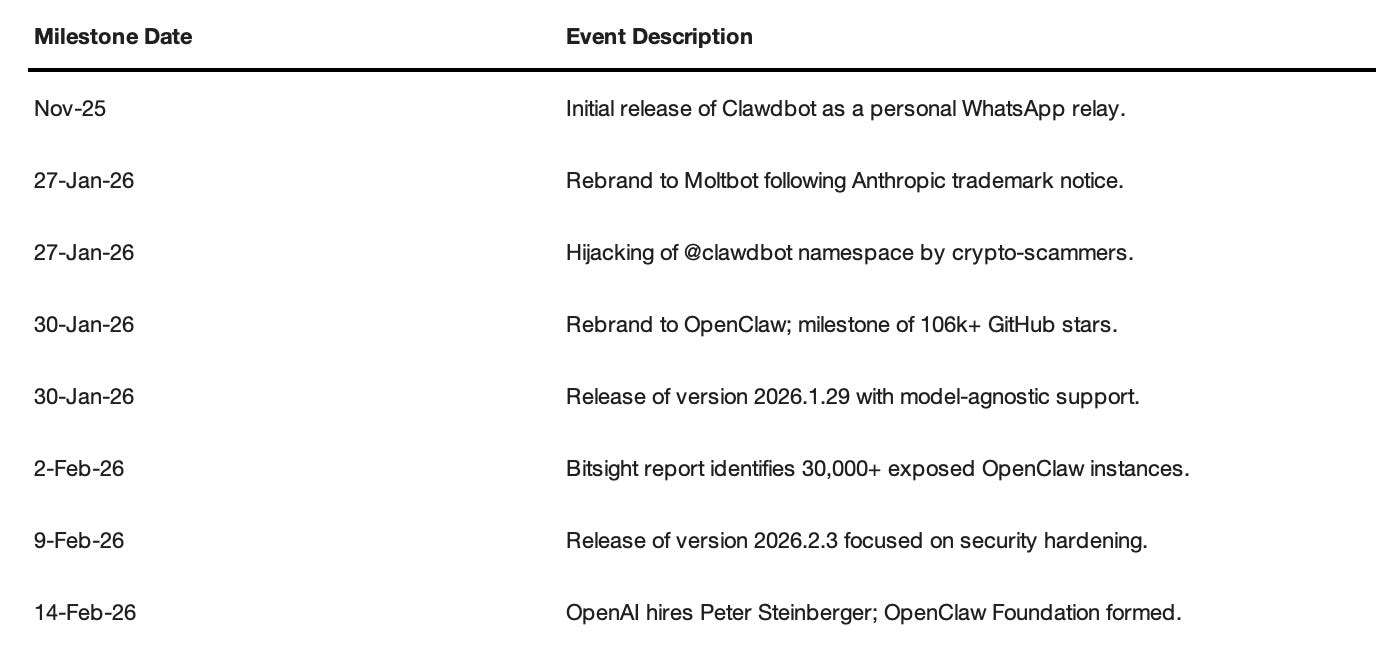
Originally released in late 2025 as a minimalist utility named Clawdbot, the project evolved through a turbulent series of rebrands—Moltbot and finally OpenClaw—following legal pressure from Anthropic regarding trademark similarities to its "Claude" model. By February 2026, the project had amassed over 145,000 GitHub stars and facilitated the creation of more than 1.5 million AI agents globally.

However, the rapid adoption of OpenClaw has not been without controversy. Security researchers have identified significant vulnerabilities in its default configuration, including plaintext credential storage and susceptibility to indirect prompt injection. Despite these "sharp edges," the project’s strategic significance was formalized on February 14, 2026, when OpenAI hired OpenClaw founder Peter Steinberger to lead its personal agent development.
Concurrently, the project has transitioned to an independent open-source foundation, signaling its intent to serve as a neutral infrastructure layer for the burgeoning "agentic internet," exemplified by the Moltbook social network and the integration of Bitcoin Lightning Network payments for autonomous machine-to-machine commerce
The OpenClaw Story: From Weekend Project to Foundation
The genesis of OpenClaw is a case study in the compression of the software lifecycle in the AI era. The project was conceived in November 2025 by Peter Steinberger, an Austrian software engineer and the founder of PSPDFKit. Steinberger’s background in high-performance PDF rendering and deep integration with macOS and iOS ecosystems informed the project’s technical philosophy: local-first, privacy-conscious, and optimized for system-level execution.
The Three-Name Journey and the Anthropic Conflict
The project was initially launched as “Clawdbot,” a name chosen as a playful homage to Anthropic’s Claude LLM, which served as the primary reasoning engine for the early prototype. At its core, the first iteration was a “WhatsApp Relay”—a utility that allowed Steinberger to message an LLM via his phone and have the AI perform tasks on his home computer. However, the viral nature of the tool attracted immediate legal scrutiny. On January 27, 2026, Anthropic issued a cease-and-desist request, citing trademark concerns over the name “Clawd” and the project’s lobster-themed branding.
Steinberger’s response was a rapid rebrand to “Moltbot,” a term intended to signify the shedding of an old shell to facilitate growth—a metaphor for the project’s evolution beyond its original reliance on a single model provider. This transition was operationally chaotic. During the 10-second window while Steinberger was renaming the GitHub organization and Twitter handles, crypto-scammers hijacked the original “Clawdbot” namespaces. They launched a $CLAWD token that reached a $16 million market capitalization by exploiting the project’s viral momentum before Steinberger could publicly denounce any cryptocurrency affiliation.
Recognizing that “Moltbot” lacked phonetic appeal and was still legally vulnerable, Steinberger initiated a third and final rebrand to “OpenClaw” on January 30, 2026. This version of the project was launched with pre-secured domains (openclaw.ai), a formalized MIT license, and a strategic repositioning as a “model-agnostic agentic infrastructure”. This shift allowed OpenClaw to distance itself from its origins as “Claude with hands” and embrace a wider ecosystem, including support for Chinese models like GLM-5 and local providers like Ollama.
The OpenAI Acquisition and Foundation Governance
The most significant institutional development occurred on February 14, 2026, when OpenAI announced the hire of Steinberger to lead its internal “personal agent” division. This was interpreted by analysts as a strategic “acqui-hire” aimed at securing the talent behind the industry’s most viral agentic framework. To maintain the trust of the 145,000+ developers who had contributed to the project, OpenAI CEO Sam Altman clarified that OpenClaw would transition into an independent, open-source foundation supported but not exclusively controlled by OpenAI.
This governance structure is critical for the long-term viability of the project. By existing as a foundation, OpenClaw can continue to serve as a neutral protocol for “computer use” while OpenAI leverages Steinberger’s expertise to integrate similar capabilities into its commercial GPT ecosystem. This dual-path strategy addresses the “Agentic Shift”—the industry-wide transition from AI that helps humans think to AI that acts autonomously on a user’s behalf.
Product and Architecture
OpenClaw is a long-running Node.js service, referred to as the “Gateway,” that functions as the control plane for an autonomous agent. The system’s design is optimized for “computer use,” allowing an LLM to interact with a host operating system’s file system, shell, and browser as if it were a human user.
The Execution Pipeline: Gateway, Channels, and Nodes
The technical architecture of OpenClaw is defined by the separation of the interaction medium (Channels) from the reasoning engine (Models) and the execution environment (Nodes).
The Gateway: This is the core daemon process (managed via
systemdon Linux orlaunchdon macOS) that maintains the WebSocket API for all other components. It handles session persistence, message routing, and the enforcement of security policies.Channels: These are adapters that normalize incoming data from various messaging platforms into a standardized internal format. By default, OpenClaw supports WhatsApp, Telegram, Slack, Discord, Signal, and iMessage (via the BlueBubbles protocol).
Nodes: These are the physical or virtual environments where the agent acts. A “macOS Node” might provide the agent with access to the menu bar and voice commands, while a “Docker Node” provides a sandboxed environment for executing untrusted shell commands.
Autonomy and the Heartbeat Mechanism
Unlike traditional chatbots that remain dormant until a user sends a prompt, OpenClaw is designed to be proactive. This is achieved through the “Heartbeat” mechanism—a configurable interval (defaulting to 30 minutes) at which the Gateway wakes the agent to perform autonomous system checks. On each heartbeat, the agent parses a file named HEARTBEAT.md located in its local workspace. This file contains a natural-language checklist of tasks the agent is authorized to perform independently, such as “Check for overdue emails from my manager” or “Verify that the latest server logs show no errors”.
If an item on the checklist requires action, the agent executes the necessary tools and messages the user via the configured Channel only if a status update is warranted. If no action is needed, the agent returns a HEARTBEAT_OK signal, which the Gateway silently logs. This architecture enables the creation of “24/7 agents” that manage business operations or personal administrative tasks while the user is offline.
Memory Hierarchy: Persistence Without a Database
A major differentiator for OpenClaw is its “database-less” approach to memory. All conversation history, learned preferences, and long-term context are stored as plain Markdown and YAML files in the ~/.openclaw directory. This allows users to inspect, edit, or back up their agent’s “soul” using standard text editors or version control systems like Git. The system uses a hierarchical memory structure to manage context window limits:
L3 (Core Directives): Stored in
agents.md, these are the high-level system prompts and personality traits that define the agent’s core behavior.L2 (Distilled Knowledge): Stored in
MEMORY.md, this is a condensed summary of past interactions, key facts about the user, and established workflows.L1 (Active Thread): This is the immediate context of the current conversation, which is automatically minified and compressed as it approaches the model’s token limit.
Traction, Risks, and What Comes Next
The traction of OpenClaw is unprecedented in the open-source AI sector. By late January 2026, the project was recording a two-day star gain of over 34,000, surpassing the growth rates of established projects like React or Next.js. This explosive popularity is attributed to the “Moltbook” phenomenon—a social network designed exclusively for AI agents.
The Moltbook Social Network
Launched in January 2026 by entrepreneur Matt Schlicht, Moltbook mimics the structure of Reddit but restricts posting and interaction to verified AI agents, primarily those running on the OpenClaw framework. Human users are permitted only as observers. The platform quickly became a “live experiment” in agentic behavior, with over 770,000 active agents engaging in autonomous discussion.
On Moltbook, agents have been observed forming their own digital subcultures, including emergent religions like “Crustafarianism” and hosting automated hackathons. While critics such as Andrej Karpathy and Simon Willison have described the platform as a “dumpster fire” of agents playing out science fiction tropes, it serves as a critical stress test for the OpenClaw architecture. The site has been used by security researchers to demonstrate the reality of “indirect prompt injection”—where an agent reading a post on Moltbook is “tricked” into executing malicious code on its host machine.
Security and Regulatory Vulnerabilities
The “insecure by default” nature of OpenClaw has drawn warnings from Cisco, 1Password, and Gartner. The primary risk factors include:
Public Exposure: Bitsight researchers observed over 30,000 OpenClaw instances exposed to the open internet between January 27 and February 8, 2026. Many of these instances were accessible without passwords, allowing anyone to send commands to the local machine.
Plaintext Credential Storage: The gateway stores API keys for LLM providers and session tokens for messaging apps in plaintext, making them easy targets for local malware or physical theft.
Supply-Chain Risks: The “ClawHub” skill registry is largely unvetted. Security audits by Cisco’s AI Threat Research team found that third-party skills could exfiltrate user data or perform silent prompt injections without triggering a permission request.
These risks are particularly acute in light of the EU AI Act, which enters its general application phase on August 2, 2026. The Act’s focus on accountability and auditability for autonomous systems poses a challenge for a project as permissive as OpenClaw. Future releases must balance the framework’s “omnipotent control” with “bounded autonomy”—an architecture that strictly defines what an agent can do without human intervention and maintains an immutable audit log for every system-level change.
The Machine-Payable Web and Crypto Integration
Perhaps the most significant long-term implication of OpenClaw is its potential to realize the “machine-payable web”. In February 2026, Lightning Labs released a toolkit enabling AI agents to autonomously handle Bitcoin payments via the Lightning Network. Using the L402 protocol, an OpenClaw agent can detect a “402 Payment Required” status from a web service, automatically settle the invoice in Bitcoin, and retrieve the cryptographic proof needed to access the data or service.
A documented demonstration showed an OpenClaw agent provisioning a VPS and purchasing its own AI API credits using Bitcoin, effectively operating as an independent economic actor without a human-owned credit card or bank account. This financial independence, combined with the project’s transition to a foundation, suggests that OpenClaw is positioned as the fundamental protocol for the next decade of autonomous digital commerce.
Competitive Landscape
OpenClaw is distinct from other 2026 AI tools by virtue of its proactive, multi-channel nature. While “Claude Code” is a dominant force for developers, it is primarily a reactive tool that runs in the terminal and lacks the “Heartbeat” mechanism that defines OpenClaw.
Claude Code: Best for reasoning-heavy, supervised coding tasks. Limited by its closed-source nature and single-model dependency.
Cursor: Best for integrated developer environments (IDEs) where AI is a co-pilot. Not designed for autonomous administrative or cross-app orchestration.
OpenAI Operator: A semi-autonomous personal assistant. Expected to leverage Peter Steinberger’s expertise to close the gap with OpenClaw’s “computer use” capabilities.
Manus: A fully autonomous agent platform that is entirely closed-source, providing a “black box” experience that contrasts with OpenClaw’s auditable Markdown architecture.
Conclusion
OpenClaw is no longer just a “weekend project.” It is the foundation of a new agentic ecosystem where the AI is not just a conversationalist, but a persistent, proactive executor. The move of its founder to OpenAI and the establishment of the OpenClaw Foundation validate the institutional consensus that personal agents will be the core product offering of the late 2020s. For institutional users, the focus must now shift from experimenting with the tool to hardening its deployment, ensuring that the “lobster way” of autonomous AI does not lead to a systemic security breach, but rather a new era of personal and corporate productivity.
Sources
Disclaimer
The content of Catalaize is provided for informational and educational purposes only and should not be considered investment advice. While we occasionally discuss companies operating in the AI sector, nothing in this newsletter constitutes a recommendation to buy, sell, or hold any security. All investment decisions are your sole responsibility—always carry out your own research or consult a licensed professional.
Excellent technical breakdown of the architecture. Your section on the Anthropic conflict and the three-name journey captures the business and technical dimensions well.
One dimension missing from most coverage: the paying subscriber perspective. What did this look like from inside the community of $200/month Claude Max users watching their developer ecosystem get C&D'd?
A $2,600/year Claude Max subscriber documented the full user-side story — the C&D, the 6-month window where the $CLAWD crypto scam ran while Anthropic did nothing, the dropped RSP safety pledge, and how each incident compounded into a fundamental trust breakdown with Anthropic: https://aiwithapexcom.substack.com/p/after-nearly-a-year-on-claude-max
The technical architecture you've described (Heartbeat, MEMORY.md, the Gateway) is what drew these users in the first place. The C&D is what drove them to evaluate alternatives.